
Beef Buying Guides
Buying Beef Online for the First Time? Start Here.
Know what to ask, what to expect, and what to do when your beef arrives.
01 · Where does the beef actually come from?
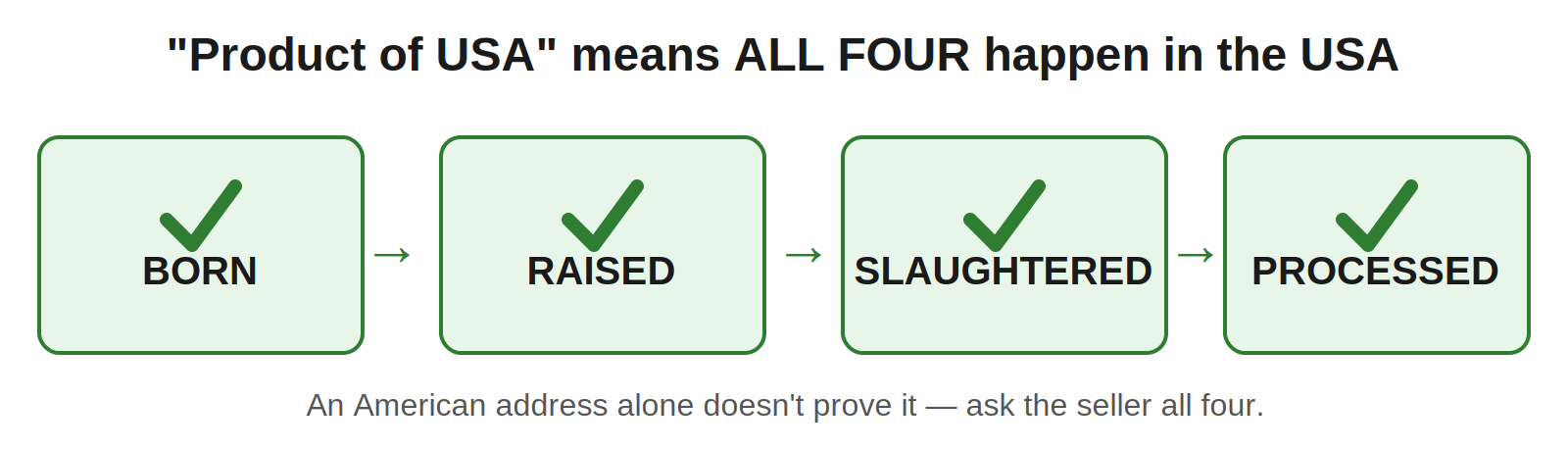
An American business address doesn’t mean American beef. Ask where the animal was born, raised, slaughtered, and processed — all four.
Since January 2026, USDA’s voluntary “Product of USA” label requires all four steps to happen in the United States. But the label is voluntary, so its absence doesn’t prove foreign origin either.
When in doubt, ask:
“Where were your cattle born and raised, and where is the beef processed?”
02 · What exactly am I buying?
Four common ways to buy. Pick your starting point:
Individual cuts — specific steaks, roasts, ground beef. Check package weights.
Beef boxes — a curated selection in one order. Confirm contents and substitutions.
Subscriptions — recurring deliveries. Check how to skip, pause, or cancel.
Quarter / half / whole beef — a share of the animal, often with processing choices. Ask how many pounds of packaged, take-home beef to expect.

03–04 · What will I actually pay per pound?
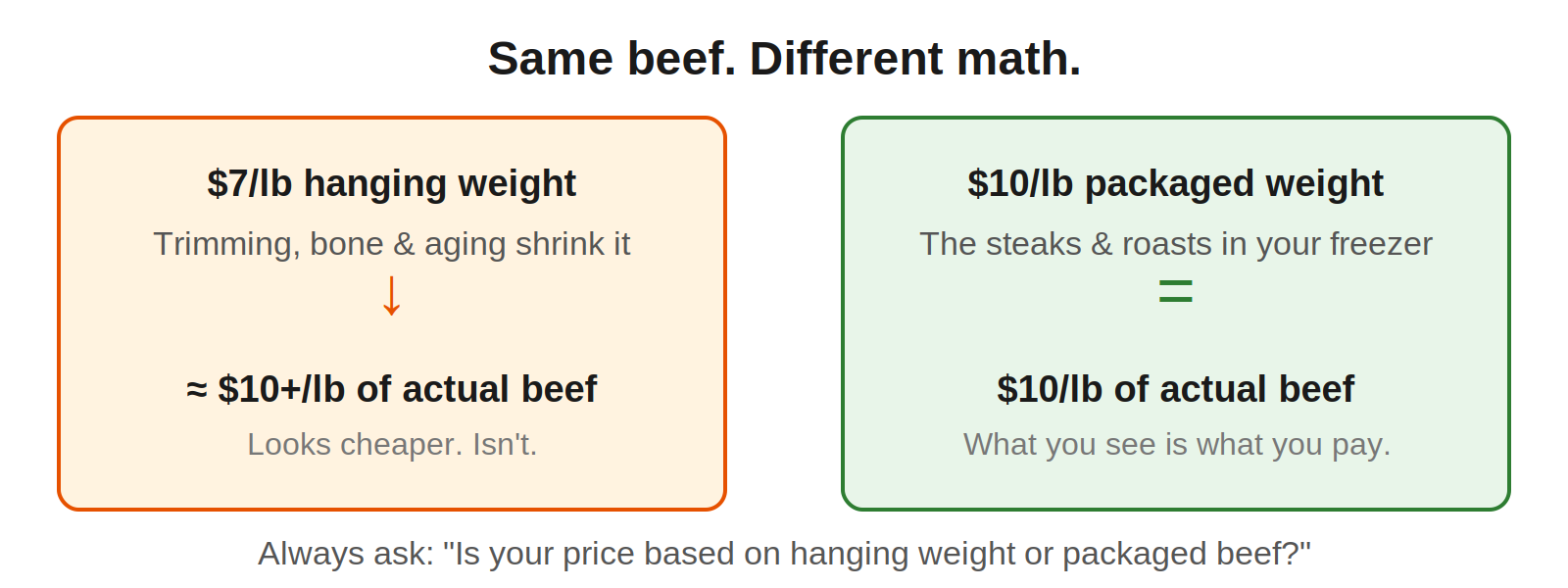
A $7/lb quote can mean $10+/lb of actual beef. It depends which weight the price is based on:
Live weight — the animal before processing. (You never pay on this.)
Hanging weight — the carcass after slaughter, before cutting. Most ranch quotes use this.
Packaged weight — the steaks, roasts, and ground beef going into your freezer. This is the number that matters.
Trimming, bone removal, and aging shrink hanging weight down to packaged weight — so a hanging-weight price is not your per-pound cost.
“Is your advertised price based on hanging weight or the pounds of packaged beef I actually receive?”
Compare with one number: estimated delivered cost per pound. (Beef + required processing + required fees + shipping) ÷ estimated packaged pounds.
Get each cost in writing, count each one once, and don’t compare ranches on price-per-pound alone — a $7/lb hanging-weight quote can cost more than a $10/lb packaged-weight quote.
05 · Grass-fed, grass-finished, or grain-finished?
These describe feeding choices — not a ranking of quality. Ask what they mean in practice:
Grass-fed — grass and forage after weaning, no grain, pasture access in growing season (per USDA guidance).
Grass-finished — forage-fed through the final growing period. Ask about earlier feeding too.
Grain-finished — grain during finishing; often pasture-raised earlier in life.
“How are your cattle raised and finished?” If certification matters to you, ask who certifies it.
06 · How much freezer space do I need?
Rule: about 1 cubic foot per 25–30 pounds of packaged beef (30 in a chest freezer, 25 in an upright).
| Purchase | Packaged beef | Freezer space |
|---|---|---|
| ¼ beef | ~130 lb | ~4.5–5.5 cu. ft. |
| ½ beef | ~260 lb | ~9–11 cu. ft. |
| Whole beef | ~520 lb | ~18–22 cu. ft. |
Planning estimates, not promises — ask your seller for their expected packaged weight and use that number instead. Leave extra room; a jam-packed freezer is hard to organize.
07 · How is frozen beef shipped?
In insulated boxes with dry ice or gel packs. Before ordering, check: shipping days, transit time, tracking, and what happens if the carrier is delayed. Ask who needs to be home — and have a backup plan if no one is.
08–10 · My beef arrived — is it okay?
Dry ice is gone? Not necessarily ruined. Dry ice evaporates by design. Judge the beef, not the ice: if it still has ice crystals or is 40°F or below, it’s safe to refreeze (quality may dip). Keep a cheap digital thermometer handy.
Partially thawed? Same rule — ice crystals or 40°F or below means it can be refrozen. Never use smell, look, or taste as your safety test. Above 40°F? Don’t eat it — notify the seller.
Box damaged, warm, or late? Photograph everything (box, label, damage, beef), take a temperature reading, save your tracking info, and contact the seller right away — but don’t delay getting safe beef into the freezer while you wait.
One distinction that matters: food-safety rules and refund policies are different things. USDA sets the safety guidance; each seller sets their own refund policy.
11–12 · When your beef arrives: the checklist
- Open the box promptly
- Check the beef — ice crystals or 40°F or below?
- Inspect packaging for damage
- Freeze acceptable beef right away (freezer at 0°F or below)
- Contact the seller immediately if anything’s wrong
Track your shipment so someone’s there to receive it — or arrange for someone to collect it and refrigerate it.
Before you buy: 6 questions worth asking
- Are processing, packaging, and shipping included?
- Where were the cattle born and raised?
- How are the cattle raised and finished?
- Is the price based on hanging weight or packaged weight?
- What cuts and how many pounds of packaged beef will I get — and how much freezer space do I need?
- What's your policy if it arrives late, damaged, or too warm?
Can’t find an answer on the seller’s website? Ask before ordering.